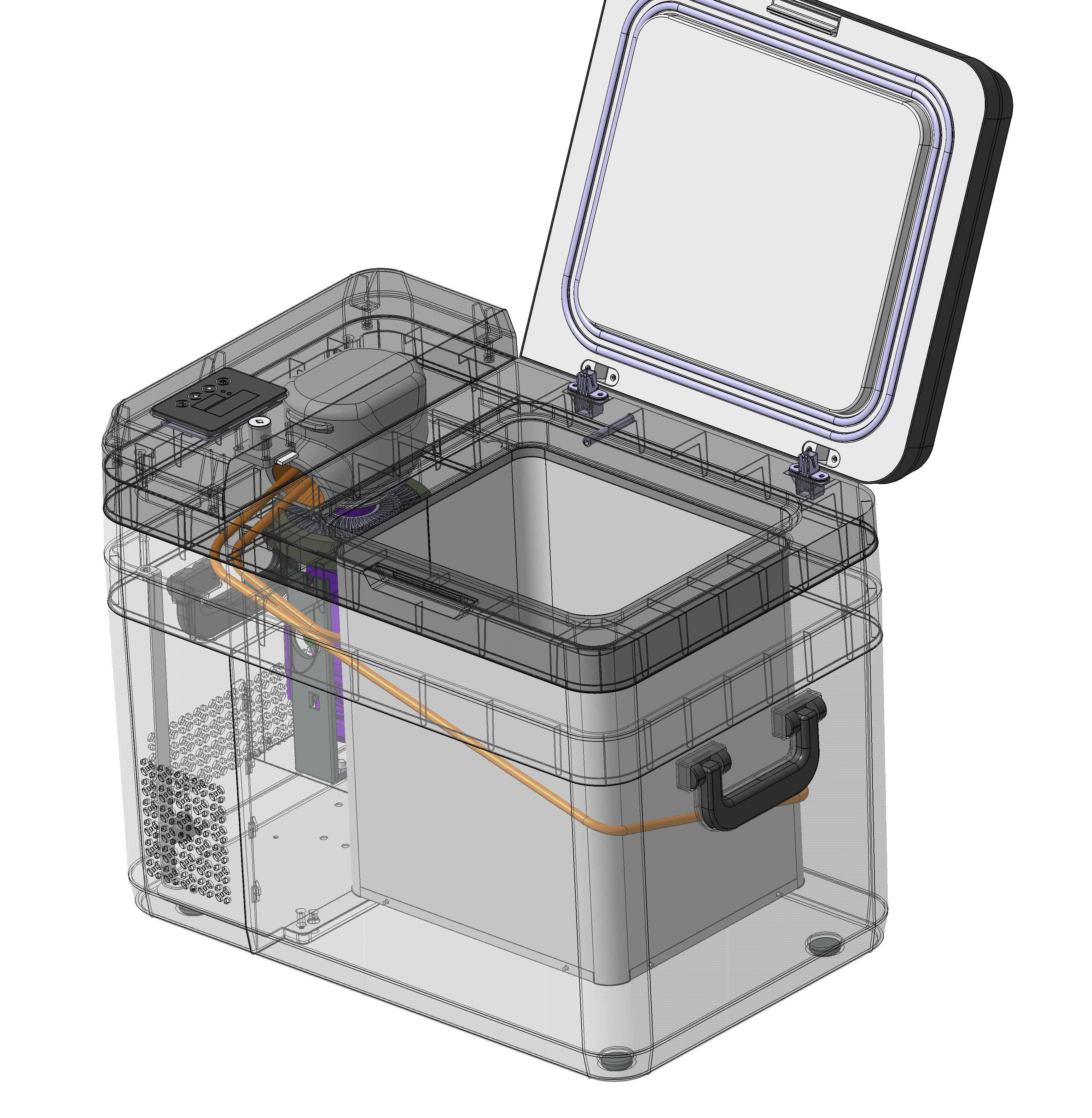
Four stages to −86 °C
A Stirling cooler is a closed-cycle heat pump. Instead of compressing a refrigerant with a piston and oil-lubricated crankcase, it shuttles a sealed charge of helium between a warm and a cold end — and lets thermodynamics do the rest.
- Compression & displacement. A helium-charged free-piston Stirling engine oscillates without bearings or lubricant, compressing and expanding the working gas.
- Continuous modulation. Engine stroke is modulated continuously rather than switched on and off, holding temperature tightly and reducing thermal cycling stress.
- Heat transport. A gravity-driven thermosiphon carries heat away from the cold head — no pump, no moving parts in the cold loop.
- Evaporation at the cold wall. R-170 (ethane) boils at the inner liner, so the whole chamber wall becomes the evaporator and freezes evenly.
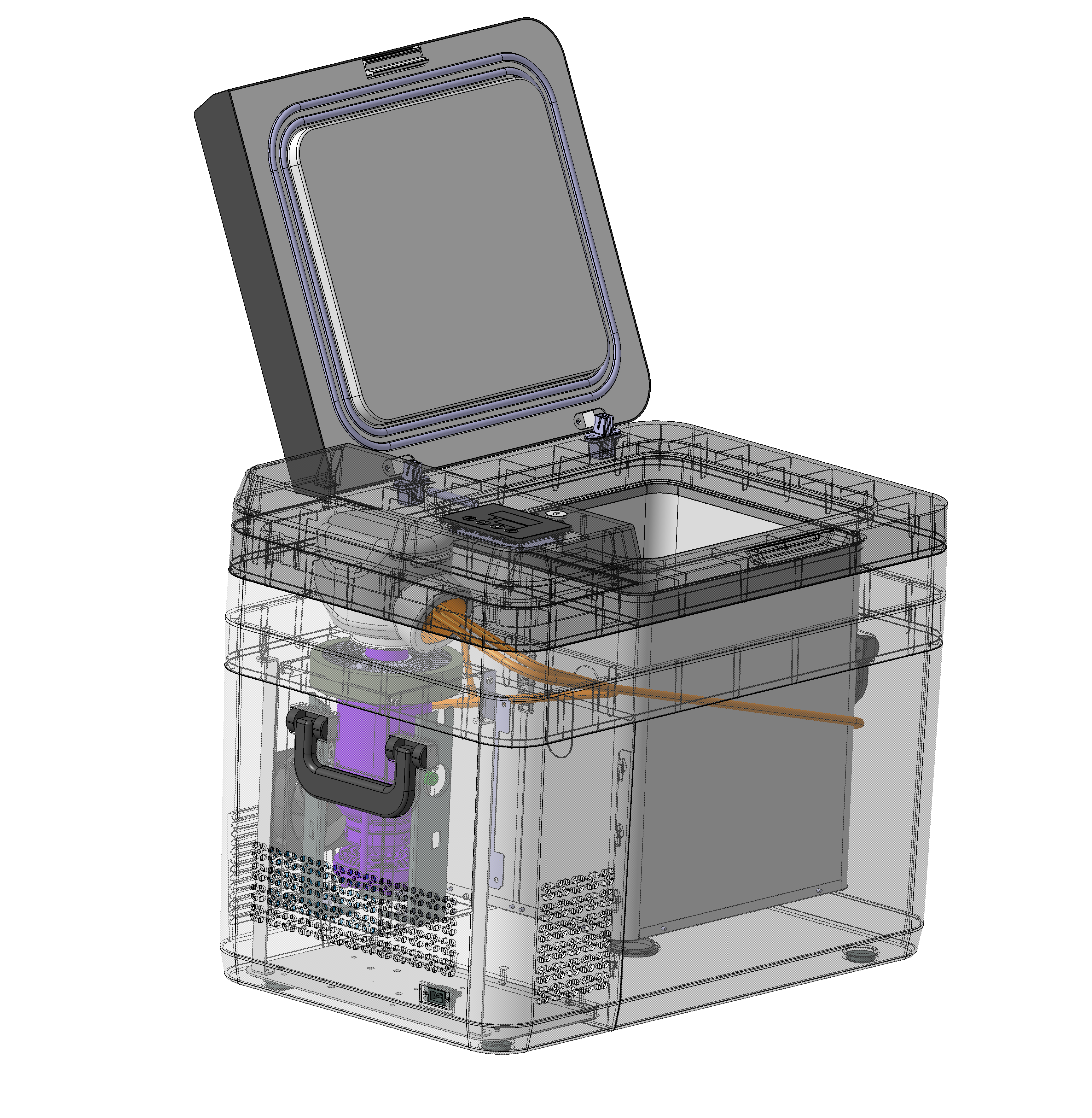
Helium-charged free-piston engine
No compressor, no refrigerant pump, no lubricating oil. The oscillating piston is the only significant moving assembly, which is why Stirling units survive transport that would shorten a compressor’s life.
Gravity-driven thermosiphon
Heat is moved by natural circulation of the working fluid rather than a mechanical pump. Fewer parts in the cold loop means fewer failure modes and no pump heat load inside the cabinet.
100 % natural refrigerants
Helium working gas plus 10–12 g of R-170 (ethane) as the refrigerant. Both are low-GWP and outside the phase-down schedules, so there is no special export classification and no restriction on air, road or sea freight.
Vacuum insulation panels
High performance vacuum insulated panels combined with polyurethane foam give a small exterior with a large usable interior — and hold temperature far longer during a power interruption.
Stirling vs. compressor vs. dry ice
| Criterion | Portable Stirling ULT | Conventional compressor ULT | Dry ice |
|---|---|---|---|
| Temperature | Adjustable −86 °C to −20 °C in 1 °C steps | Adjustable, but bulky and mains-dependent | Fixed at ≈ −78.5 °C |
| Temperature control | Continuous modulation, ±3 °C uniformity | On/off cycling with wider swings | No active control |
| Power | 100–240 V AC or 24 V DC; 120–280 W | Mains AC, high start-up current | None, but sublimates continuously |
| Consumables | None | None | Continuous dry ice supply required |
| Handling safety | Sealed system, no CO₂ build-up | Sealed system | CO₂ asphyxiation risk in vehicles, cold burns |
| Monitoring | Optional wireless logging, dry-contact alarm | Varies by model | Manual logging only |
| Noise | < 55 dB(A) at 1 m | Typically louder with compressor cycling | Silent |
| Air freight | Natural refrigerants, no special classification | Restrictions in some jurisdictions | Classified dangerous goods, limited quantities |
Comparison is indicative. Always validate against your own protocol, SOP and regulatory requirements.
Designed for a long service life
- Microprocessor controller with lockable lid for sample security
- Setpoint ±10 °C high and low alarms
- One RTD PT100 Class A control sensor
- Optional dry contacts to drive a building management or alarm system
- Optional wireless temperature monitoring and logging for audit trails
- Manual defrost and a cold-wall liner that is easy to clean